Shingles Vaccine: Who It Is Recommended For, What to Expect and How to Book
Shingles questions come up across the counter more often than you might think. I had chickenpox as a child, so am I at risk? Is there a vaccine for it? Is it free? Is it one dose or two? I have had shingles already, so is there any point?
With the HSE announcing a free shingles vaccine programme for next year, more people are asking. This guide explains what shingles is, who the vaccine is recommended for, what it involves, and how to get it with us in Sallynoggin.
What shingles is
Shingles is caused by the same virus that causes chickenpox. Once you have had chickenpox, the virus never fully leaves your body. It lies quietly in your nerves for years, sometimes decades, and it can wake up later in life as shingles, usually when your immune system is not as strong as it used to be.
It often starts with tingling, burning or pain in one patch of skin, sometimes with a headache or a general feeling of being unwell. A few days later a rash appears, usually as a band on one side of the body. It most often affects the chest or tummy, but it can also appear on the face and around the eye. The rash turns into itchy blisters that dry out and crust over, and it can take up to four weeks to heal.
Around 3 in 10 people who have had chickenpox will get shingles at some point in their lives. The risk starts to rise from about the age of 50 and keeps rising as we get older.
Why it is worth protecting yourself
For many people, shingles means a painful few weeks. For others, it lasts much longer. The most common complication is post-herpetic neuralgia, which is nerve pain that carries on for months after the rash has gone. It affects around 8 per cent of people who get shingles, and almost 20 per cent of those over 70.
Shingles near the eye can cause eye problems and, in rare cases, sight loss. It can also lead to skin infections, scarring and, rarely, weakness on one side of the face. In Ireland, shingles leads to around 100 hospital admissions for every 100,000 people aged 65 and over each year.
About the vaccine
The shingles vaccine used in Ireland is called Shingrix. It is not a live vaccine, so it cannot give you shingles, and it is safe for people with a weakened immune system, who are among the people who need it most.
It works very well. In clinical trials it reduced the risk of shingles by around 90 per cent, and it cut the risk of long-lasting nerve pain by a similar amount. Protection is expected to last for around 10 years.
Who the shingles vaccine is recommended for
The National Immunisation Advisory Committee (NIAC), which advises the Department of Health on vaccines, recommends the shingles vaccine for:
- all adults aged 65 and over
- adults aged 50 and over with a condition or treatment that weakens the immune system
- adults aged 18 and over who have had a stem cell transplant
The conditions and treatments that count include cancer (including blood cancers such as leukaemia), an organ transplant, HIV with a low CD4 count, and conditions such as rheumatoid arthritis, lupus and inflammatory bowel disease when they are treated with medicines that dampen down the immune system. Those medicines include long-term steroids such as prednisolone, methotrexate, azathioprine, JAK inhibitors and biologics.
Some younger adults aged 18 to 49 with a weakened immune system may also benefit, particularly after an organ transplant or with a blood cancer. That decision is best made with your hospital specialist, who can also advise on the right timing around your treatment.
Is it free?
Not yet. At the moment, the shingles vaccine is only available privately in Ireland. It is not covered by the medical card or the Drugs Payment Scheme.
That is due to change. In October, the Minister for Health announced that a free HSE shingles vaccine programme will begin in June 2027. It will be rolled out in phases, starting with people who are immunocompromised, then people aged over 80, and then people aged over 65.
If you are in one of the higher-risk groups, it may be worth talking to us or your GP about whether to get protected now rather than waiting. Call in or give us a ring and we can talk it through with you.
Two doses, a few months apart
Shingrix is given as two doses. The second dose is usually given 2 to 6 months after the first. For some people with a weakened immune system, the second dose can be given sooner, 1 to 2 months after the first.
You need both doses for full, long-lasting protection, so it is worth putting a reminder in your diary for the second one when you have your first. If more time than planned has passed, you do not need to start again. Just get in touch and we will arrange your second dose.
I have already had shingles. Do I still need the vaccine?
Yes, it is still recommended. Having shingles once does not stop you getting it again. If you have had shingles recently, wait until the rash has fully cleared before getting vaccinated, and ask us about the best timing for you.
Can I get it with my flu or COVID-19 vaccine?
Yes. Shingrix can be given at the same appointment as your flu or COVID-19 vaccine, in a different arm, so you do not need to make two trips. Just mention it when you book. Our flu and COVID-19 vaccine guide explains who qualifies for those this winter.
What actually happens when you come in
The visit itself only takes a few minutes.
You book a time online. When you arrive, a pharmacist brings you into our private consultation room and goes through a few short questions about your health, any medicines you take, and any allergies. This is also a good time to ask anything you want to know.
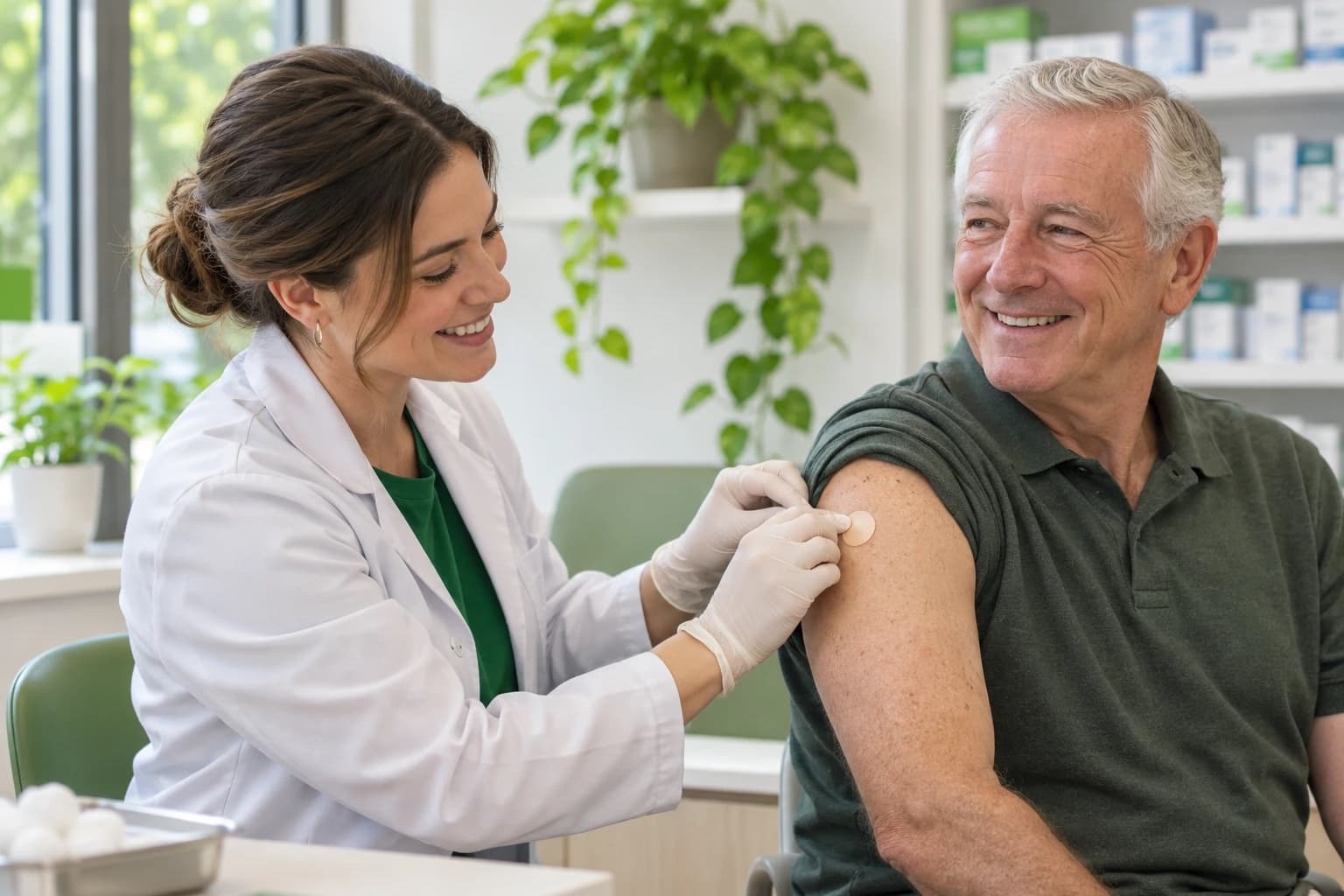
The vaccine is a small injection into the upper arm, so a short-sleeved top or a loose sleeve that rolls up easily makes things simpler. Afterwards, we ask you to wait with us for about 15 minutes before heading off, just as a precaution.
Bring a list of any medicines you take. If you have a high temperature or feel properly unwell on the day, give us a call and we will move your appointment.
Side effects
Shingrix tends to cause more of a reaction than some other vaccines, so it is worth knowing what to expect. Most people get a sore, red or swollen arm where the injection was given. Many people also feel tired, achy or shivery, or get a headache or a slight temperature, for a day or two.
These effects usually pass within 2 to 3 days, and they are a sign that your immune system is responding. It can help to book your appointment for a day when you can take things easy afterwards. Having a reaction to the first dose is not usually a reason to skip the second, but do tell us about it when you come back.
Serious allergic reactions are rare, and our pharmacists are trained to deal with them, which is one of the reasons we ask you to wait for 15 minutes.
Think you might have shingles?
Do not wait for it to clear up on its own. Antiviral medicine works best when it is started within 3 days of the rash appearing, so speak to a pharmacist or your GP as soon as you notice the signs. We can assess and treat shingles here in the pharmacy, and you can check if our shingles treatment service is right for you. If the rash is on your face near your eye, contact your GP, out-of-hours GP or emergency department straight away.
You cannot pass shingles itself on to anyone, but while the blisters are still weeping, someone who has never had chickenpox can catch chickenpox from you. Keep the rash covered, and avoid close contact with pregnant women who have not had chickenpox, people with a weakened immune system, and newborn babies until the blisters have dried.
Booking with us
We offer the shingles vaccine at Finnegan's Pharmacy in Sallynoggin. All vaccinations need a quick online booking first, so we have the vaccine ready and a pharmacist's time set aside for you.
Book your shingles vaccine online. It only takes a minute. If you would rather check whether the vaccine is right for you first, call in or give us a ring and we will be glad to help.
This guide is based on the National Immunisation Advisory Committee's recommendations and HSE information on shingles, and it does not replace advice from your GP or pharmacist. Recommendations can depend on your individual health and treatment, so if you are unsure whether the shingles vaccine is right for you, speak to us, your GP or your hospital specialist. If you have trouble breathing, swelling of the face or throat, or feel seriously unwell after any vaccine, call 112 or 999 straight away.